
Education You Can See. Growth You Can Measure.
Discover how rigorous academics, independent thinking and meaningful challenges help our students grow.
What “rigorous” means here, grade by grade
Every school says it has high standards. Here is what ours look like: the programs we use, the books students read, the writing we expect and the kind of problems they solve.
Kindergarten
Foundations of reading, number sense and attention- Mathematics
- Math in Focus (Singapore Math) five times a week, plus logic and early problem-solving.
- Reading & literature
- Phonics, sight words and real storybooks and poems. Children learn to name the characters, the setting and the main events, and to explain what an author and an illustrator each do.
- Writing
- Correct letter formation and daily handwriting practice, building toward a first complete sentence.
- Beyond the core
- Science, geography, speech, art, music, robotics and engineering every week.
Grades 1–2
From reading words to reading books- Mathematics
- Math in Focus with model drawing: students learn to draw a word problem before they solve it.
- Reading & literature
- Guided reading levels and English literature lessons, including classic tales and the first chapter books such as Little House in the Big Woods.
- Writing
- Structured paragraphs with an opening, a body and a closing; retelling a story in the student’s own words; daily six-trait writing practice.
- Vocabulary & languages
- Wordly Wise 3000; Russian literature and a second language begin in Grade 1.
Grades 3–5
Independent readers, writers and thinkers- Mathematics
- Math in Focus with acceleration where a student is ready, plus competition preparation for Math Kangaroo and MOEMS.
- Reading & literature
- English literature grows to three lessons a week by Grade 4, with whole-novel studies, discussion of characters, and evidence from the text.
- Writing
- Three writing lessons a week from Grade 3, plus grammar, vocabulary and a weekly speech class with presentations.
- Science & history
- Into Science (NGSS-aligned); history from Grade 3; biology and physics as separate subjects in Grade 5.
Middle School · Grades 6–8
The bridge to honors high-school work- Mathematics
- Pre-Algebra, Algebra I, Algebra II and Geometry pathways, designed for high-school honors and advanced placement.
- Literature
- Grade 6 reads whole classics, such as The Hobbit, The Adventures of Tom Sawyer, A Christmas Carol, Robinson Crusoe, White Fang, The Secret Garden, Around the World in Eighty Days, The Time Machine, The Old Man and the Sea, Fahrenheit 451 and The Little Prince.
- Writing
- English, grammar, vocabulary and writing taught together, with PSAT preparation.
- Thinking
- Inventive problem solving (TRIZ), research presentations, and responsible use of AI tools.
Try an olympiad problem from our classrooms
Every week, our students go beyond the textbook with olympiad mathematics, the kind of reasoning tested in Math Kangaroo and MOEMS. These problems are about thinking, not just arithmetic. Can your child solve them? Tap to see how we teach the solution.
Anna, Ben and Cara stand in a line. Anna is not first. Ben stands right behind Anna. Who is first in line?
Show the solution
Ben comes right after Anna, so Anna can’t be last. She isn’t first either, so she is in the middle and Ben is last. That leaves Cara first. Children act it out before they answer.
A snail climbs a 10-foot pole. Each day it climbs up 3 feet; each night it slides down 2 feet. On which day does it reach the top?
Show the solution
It gains 1 foot each full day and night, so it is at 7 feet after 7 nights. On day 8 it climbs 3 feet and reaches 10 feet before it can slide back. The quick answer, “day 10,” is a trap.
A drawer holds 10 red, 10 blue and 10 green socks. In the dark, how many socks must you take out to be sure you have a matching pair?
Show the solution
With bad luck, the first 3 socks are all different colors. The 4th must match one of them, so the answer is 4. This is the pigeonhole principle, an idea from olympiad math.
Tom writes every whole number from 1 to 100. How many times does he write the digit 9?
Show the solution
9 appears in the ones place 10 times (9, 19, … 99) and in the tens place 10 times (90–99). That makes 20, because 99 counts twice. Most first answers are 19.
What is the last digit of 72026?
Show the solution
The last digits of the powers of 7 repeat: 7, 9, 3, 1, 7, 9, 3, 1… 2026 divided by 4 leaves a remainder of 2, so the last digit is the 2nd in the cycle: 9.
Results that matter, visible in every notebook
Our students grow into capable, confident and independent learners. Families don’t wait for a report card to see it: it shows up in daily work, in every term’s progress report, and in competitions against students from other schools.
Academic Growth
Strong reading comprehension, advanced writing skills and mathematical confidence, built through five math lessons a week, real books and daily writing.
Future Readiness
Critical thinking, problem-solving, public speaking, leadership and academic independence. Our students learn to explain and defend their thinking.
Prepared for What Comes Next
Students leave ready for selective high schools, advanced coursework, STEM pathways and lifelong learning, with Algebra and Geometry within reach in middle school.
Independent test results: coming soon. After our first full cycle of independent testing, we will publish grade-level results on this page.
Real work by real students, names removed
Real notebooks, essays and projects, plus short videos from real lessons. This is the clearest picture of what happens in our classrooms every day.
Opening, body, closing
A first-grader’s first structured paragraph, written at the end of the school year.
Sample coming soonDrawing the problem first
A student’s notebook page: the bar model, the number sentence and the check.
Sample coming soonBuild, test, explain
A 60-second look at a STEAM lesson where students defend how their design works.
Video coming soonEvidence from the text
A written answer that names the character, the moment and the reason.
Sample coming soonPresenting to the class
A student research presentation, with questions from classmates.
Video coming soonFinding my own mistake
A corrected test: the student explains the error and solves it again.
Sample coming soonEvery sample is shared with written permission from the family. Names, faces and anything that could identify a child are removed before anything is published.
How our teachers teach, not just where they studied
Degrees matter, but parents deserve to know more: how each teacher explains a new idea, what they expect from students, and what their feedback actually looks like.
What our feedback looks like
Here is an example of how a teacher responds to a student’s work. Every response follows the same format: what works, what to fix, and the next step.
Leo has 27. 36 + 27 = 63
They have 63 stickers.
- What works: You noticed your first answer didn’t make sense and you fixed it yourself. That is exactly what good mathematicians do.
- What to fix: “9 more” is about Mia, not Leo. Read the sentence again and say who has more.
- Next step: Draw the two bars before you write any numbers. Try the next problem that way.
Great teachers change lives
Parents trust people more than programs. Meet the teachers who will know your child by name.

Mrs. Holyk
Elementary TeacherKnown for her high expectations and caring approach, Mariia helps students achieve strong academic growth while building confidence, independence and a love of learning.
Accessible & responsive
Our teachers communicate closely with families and know every child by name. Parents receive regular updates on academic progress, classroom achievements and areas for growth. At Blooming Minds, students are never just a number: they are known, valued, challenged and celebrated as individuals.
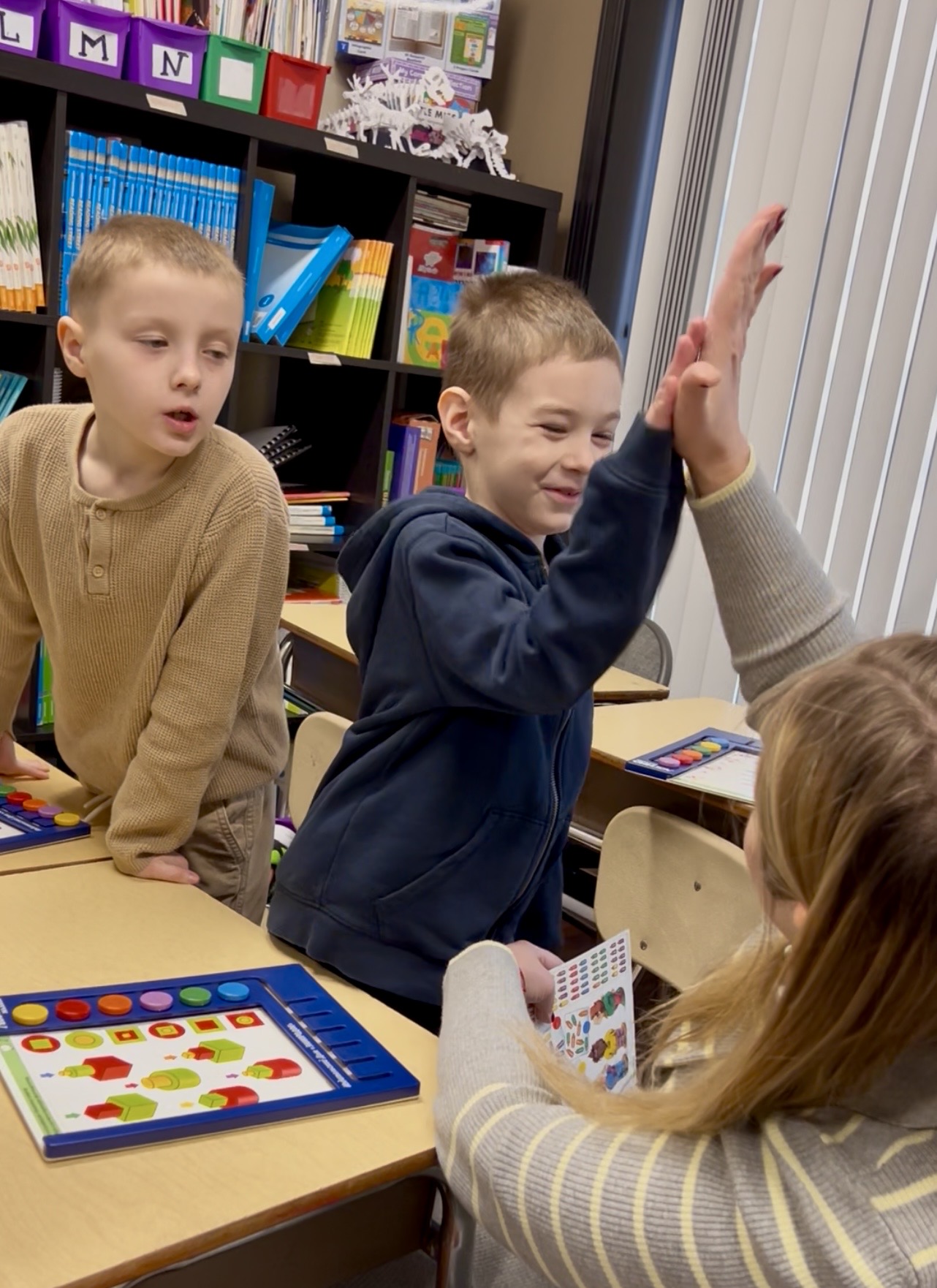
High expectations with care
Students receive support, encouragement and meaningful academic challenge, and celebrate when they get it right.
Don’t take our word for it. Come and watch a real lesson.
- Tour the school and meet the people who will teach your child.
- Sit in on a real class, not a staged demonstration.
- Look through student notebooks and ask us anything about our standards.